Showing posts with label technology. Show all posts

Wednesday, October 05, 2011

RIP Steve Jobs


"No one wants to die. Even people who want to go to heaven don't want to die to get there. And yet death is the destination we all share. No one has ever escaped it. And that is as it should be, because Death is very likely the single best invention of Life. It is Life's change agent. It clears out the old to make way for the new. Right now the new is you, but someday not too long from now, you will gradually become the old and be cleared away. Sorry to be so dramatic, but it is quite true. Your time is limited, so don't waste it living someone else's life. Don't be trapped by dogma — which is living with the results of other people's thinking. Don't let the noise of others' opinions drown out your own inner voice. And most important, have the courage to follow your heart and intuition. They somehow already know what you truly want to become. Everything else is secondary." - Steve Jobs
from the prepared text of the Commencement address delivered by Steve Jobs, CEO of Apple Computer and of Pixar Animation Studios, on June 12, 2005

Monday, November 17, 2008

Death Watch for the Watch?

My Watches

Numerous folks commenting on this Wired post had the same thought that I did: the watch is the sixth gadget getting killed by the cell phone. (Tangentially, the mobile phone hasn't killed the laptop. It has, however, knocked off the beeper.)

Most of us grew up with watches and not cell phones. What happens with folks who grew up having both? I would be surprised if watch sales don't decline. Turns out they have already -dramatically - in some parts:

From a 2006 Businessweek article "Time's up for watch sales in Japan":
According to a new survey by Seiko Watches, the proportion of Japanese aged between 16-49 wearing wristwatches has plummeted from 70% in 1997 to 46% today. The culprit, if you haven’t already guessed, is the mighty cell phone.
Another study shows clock and watch sales both falling five percent in 2005 after four years of slow growth. Much more recently, this September '08 IHT article details declining watch sales - in this case due to the slumping economy. And anecdotally, a collegue says his wife is an 8th-grade teacher and some of her students can't tell time via a regular clock or watch. "If it wasn’t for their cell phone, they wouldn’t know what time it is."

So in the not-too-distant future, will watches be like Captain Kirk's Kirk antique bifocals? They weren't generally really necessary – just more of a antique instrument kept around for nostalgia's sake. I suspect people will keep them around for that reason, as well, of course as (often gaudy) status symbols

Lest you think this as death of the watch Schadenfreude, I have three working watches (depicted above), plus two or three others I just don't seem to be able to part with. Since none of them would fetch more than 50 bucks on eBay, guess I fit into the nostaglia category.

Sunday, February 17, 2008

Nothing New

The Economist notes that Twitter is being used by journalists during election coverage as a tool akin to cablese, which journalists used in the early 20th century.

The Economist also recently noted that the first occurrence of spam was probably in 1864, when British politicians received telegrams in the middle of the night, which turned out to be advertisements for dentistry. They very suitably annoyed, much in the way we were to get phone calls from MCI at dinner time or Viagra ads in our email. (Oh yeah, still get the latter.) It's hard to think of what life was like before the phone, but you can imagine:
In 1903 the trade journal Telephony reported an elderly woman's complaints about her niece, who received a phone call from a male friend while dressing. “The two of them stood talking to one another just as if they were entirely dressed and had stopped for a little chat on the street! I tell you this generation is too much for me,” she grumbled.
Telephone protocol also differs around the world: in parts of Scandinavia, people text you first to get your permission to call (I kinda like that), and in Japan using your phone for spoken conversations on the train is verboten, although phones work there. If we get connectivity on the subway here in New York (and you can guarantee we will), I hope that's a custom that's appropriated here, pronto.

Related: NPR's News Blog Twitter feed | New York Times Politics feed

Monday, May 14, 2007

A Is for Aardvark

Reality provides us with facts so romantic that imagination itself could add nothing to them.

- Jules Verne
For my money, the Encyclopedia of Life would have to be the single most exciting project Avenue A | Razorfish has been associated with since I began working there. AARF has produced a video and preliminary IA and design for the Wiki-like site, which intends to catalog the earth's 1.8 million named species.

The Boston Globe has a great writeup, which quotes the eminent biologist, E. O. Wilson, one of the program's founders:
Our ignorance is dangerous. Life forms with which we've shared the planet are going extinct at an alarming rate -- usually before we even determine what they are and what role they play in the ecosystem. Our knowledge of biodiversity is so incomplete that we are at risk of losing a great deal of it before it is even discovered.
The Washington Post also has an article, which reminds us that perhaps as little as 10% of the world's species have been cataloged.

Friday, April 27, 2007

Connectivity

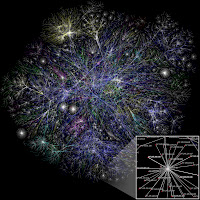
A map depicting the connected nodes of the Internet
We say that inseparable quantum interconnectedness of the whole universe is the fundamental reality, and that relatively independent behaving parts are merely particular and contingent forms within this whole.
- David Bohm
The cover article of this week's Economist "When Everything Connects" concerns the coming wireless revolution, and how not just our phones and computers connect, but how everything will soon be connected - our fridges, our cars, our toaster, our fire alarms ... paint, that can of baked beans in the back of your cupboard - everything.

The thing I hope this connectivity helps us to realize is - everything already is and always has been connected. (Without waxing too pretentious, that's the loose excuse of a theme for this blog: hitched to everything.) If we're lucky, if we don't stay blind to the fact, maybe these technological advances can serve as visible metaphors for the fact that everything in the universe acts and interacts with every other thing. Furthermore, the differences we perceive among ourselves are astonishingly superficial, when you remember that we're all composed of the swarming collection of atoms, that each of our bodies contains atoms from an extraordinarily array of objects, creatures and people, which preceded us.

Some people worry that science is sapping our lives of mystery, and that only religion can offer us meaning, prevent us from all flying apart at the seams morally and devolving into savages. Nonsense. The truth is, understanding the nature of the universe, our connectivity within that universe, and the presumed rarity of consciousness within it should only help us better understand our need to get along, to overlook our trivial differences.

Because here is what we know: we each are all minuscule portions of the universe, asleep for eons, now awakened, consciousness. We are the universe considering itself.

When you understand that, how can fail to find life and consciousness especially precious - in whatever its form?