Showing posts with label Strangelove. Show all posts

Friday, September 28, 2007

Strangelove Watch

Dr. Strangelove

A new feature wherein we draw attention to conservatives* salivating over the prospect of preemptive missile strikes against Iran. Let's begin with not one, but two recent contributions:
All the damaging consequences of all the blunders the President has committed to date in Iraq are reversible in 48 to 72 hours - the time it will take to destroy Iran's fragile nuclear supply chain from the air. And since the job gets done using mostly stand-off weapons and stealth bombers, not one American soldier, sailor or airman need suffer as much as a bruised foot. - Dan Friedman on American Thinker (Via Andrew Sullivan)
If we were to bomb the Iranians as I hope and pray we will, we’ll unleash a wave of anti-Americanism all over the world that will make the anti-Americanism we’ve experienced so far look like a lovefest. - Norman Podhoretz
Thank God these guys aren't running the country, right? Oh, right, Podhoretz is an advisor to Bush and senior foreign policy advisor to Rudy Giuliani.

*happy to throw in any moderates or liberals who fit the profile, too

Saturday, April 22, 2006

Say What?

Strangefeld

This fun little app lets you quickly add speech bubbles to any picture. Drawbacks: you can't resize the bubble for longer quotes (though you can move it around), and it doesn't handle special characters. Hence the missing umlaut. Update: SayWhat creator Zach tells us in comments that you can reshape the speech bubble by hitting enter at the desired point. Thanks Zach.

Disclaimer: Despite wishing to maintain a moderate and sensible point of view, this blog makes no apologies for comparing our nation's Secretary of Defense to Stanley Kubrik's Dr. Strangelove. We will, however, concede to the point that such comparisons are less than novel.

But, when even The Economist is calling for Rumsfeld's resignation, there's hardly much controversy, is there?

Friday, February 24, 2006

Dr. Strangelove: Or How I Learned to Stop Worrying & Love the Civil War

how I learned to stop worry and love the civil war

New and extraordinary evidence that Donald Rumsfeld was pushing to tie Iraq to 9/11 immediately after the event - whether such ties existed or not. Department of Defense staffer Stephen Cambone took notes during meetings with Rumsfeld on the afternoon of September 11, 2001. Here's some of what he wrote:
"[b]est info fast . . . judge whether good enough [to] hit S.H. [Saddam Hussein] at same time - not only UBL [Usama Bin Laden]"

"Go massive . . . Sweep it all up. Things related and not."

"Hard to get a good case."
No shit, Sherlock.

Anyone still doubting this administration manufactured consent for the war?

(Via the the inimitable Andrew Sullivan)

Elsewhere, National Review founder William F. Buckley bluntly declares "One can't doubt that the American objective in Iraq has failed."

Nothing but utter silence in response from the folks now running the Review.

Update: And let's not forget Francis Fukuyama, who now says:
As we approach the third anniversary of the onset of the Iraq war, it seems very unlikely that history will judge either the intervention itself or the ideas animating it kindly. By invading Iraq, the Bush administration created a self-fulfilling prophecy: Iraq has now replaced Afghanistan as a magnet, a training ground and an operational base for jihadist terrorists, with plenty of American targets to shoot at. The United States still has a chance of creating a Shiite-dominated democratic Iraq, but the new government will be very weak for years to come; the resulting power vacuum will invite outside influence from all of Iraq's neighbors, including Iran. There are clear benefits to the Iraqi people from the removal of Saddam Hussein's dictatorship, and perhaps some positive spillover effects in Lebanon and Syria. But it is very hard to see how these developments in themselves justify the blood and treasure that the United States has spent on the project to this point.
He concludes with words I agree with almost completely:
Neoconservatism, whatever its complex roots, has become indelibly associated with concepts like coercive regime change, unilateralism and American hegemony. What is needed now are new ideas, neither neoconservative nor realist, for how America is to relate to the rest of the world — ideas that retain the neoconservative belief in the universality of human rights, but without its illusions about the efficacy of American power and hegemony to bring these ends about.
I would make this point though: a belief in "the universality of human rights" is hardly unique to any strain of the conservative movement. Human rights shouldn't be a left/right issue, even if in practical terms they often are. Having said that, when conservatives finally and unequivocally accept that gays rights are human rights, too, I'll probably find the idea of a neoconservative belief in "the universality of human rights" a little more feasible.

Thursday, February 17, 2005

Strangefeld


Rumsfeld in full-blown Strangelove mode.

Amusing WaPo article on how Rummy's alienating friends and foes alike. He tried quitting twice. Maybe he's hoping third time lucky?

Here's a classic Rumsfeldian exchange from the article:
When the ranking Democrat on the House Armed Services Committee, Rep. Ike Skelton (Mo.), asked about the number of insurgents in Iraq, the secretary said, "I am not going to give you a number for it because it's not my business to do intelligent work." (He presumably meant to say "intelligence.") Ultimately, Rumsfeld admitted he had estimates at his fingertips. "I've got two in front of me," he said.

"Could you share those with us?" Skelton inquired.

Not just now, Rumsfeld said. "They're classified."
I do have to say: at least, he's entertaining.

Friday, December 03, 2004

Gentlemen, You Can't Fight in Here! This is the War Room.

I stumbled across this 1963 review of Dr.Strangelove, and it's fascinating to see how it reviewed at the time. Now, I happen think Strangelove is perhaps the best satirical movie of all time and to a certain extent the NYT's reviewer Bosley Crowther saw the movie's value, too. Crowther's conclusions about the film, however, prove far more conservative than mine--perhaps indicative of how much more respect was expected of your average American for the government at the time:
As I say, there are parts of this satire that are almost beyond compare.

On the other hand, I am troubled by the feeling, which runs all through the film, of discredit and even contempt for our whole defense establishment, up to and even including the hypothetical Commander in Chief.

It is all right to show the general who starts this wild foray as a Communist-hating madman, convinced that a "Red conspiracy" is fluoridating our water in order to pollute our precious body fluids. That is pointed satire, and Sterling Hayden plays the role with just a right blend of wackiness and meanness to give the character significance.

But when virtually everybody turns up stupid or insane—or, what is worse, psychopathic—I want to know what this picture proves. The President, played by Peter Sellers with a shiny bald head, is a dolt, whining and unavailing with the nation in a life-or-death spot. But worse yet, his technical expert, Dr. Strangelove, whom Mr. Sellers also plays, is a devious and noxious ex-German whose mechanical arm insists on making the Nazi salute.

And, oddly enough, the only character who seems to have much common sense is a British flying officer, whom Mr. Sellers—yes, he again—plays.

The ultimate touch of ghoulish humor is when we see the bomb actually going off, dropped on some point in Russia, and a jazzy sound track comes in with a cheerful melodic rendition of "We'll Meet Again Some Sunny Day." Somehow, to me, it isn't funny. It is malefic and sick.
My thought: yes, Kubrick's movie was uniform in its satire reserving little sympathy for any of the parties involved. That's because it's a satire. And the stuff that bothers Crowther is the same stuff that always bothers critics of great (and I mean "great" as in "of major significance or importance") satire: it is unflinching in its engagement. But satire only undermines its own purpose--its very authority and integrity--if proves anything less than an equal opportunity critic. Satire should be beholden to no one.

I'm glad Stanley Kubrick didn't choose to preserve figures like the United States President and members of the military from judgment due to some misguided sense of nationalism or respect. Of course, Kubrick was practically British, too (though born in the Bronx), so he had little reason to bow and scrape before POTUS.

Dr. Strangelove remains one of my favorite movies to this day. And, clearly, it still proves disturbingly relevant.

Also, that last line about the movie's denouement being "malefic and sick." No, no, no. Satire doesn't have to have a happy ending. (Do satires ever *really* have a happy ending? Really?) Satire is a funhouse mirror held up to society; it's a surgeon's scalpel which must lacerate in order to heal. It doesn't show a pretty picture; it doesn't tickle and tantalize with a dull blade.

Now, a society that pursues a nuclear policy dubbed MAD--for Mutually Assured Destruction--now that's malefic and sick. And respect for the Commander in Chief ought not to be considered a given.

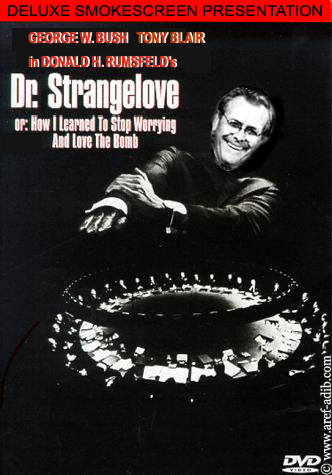
Related: Check out this updated version of the movie poster, too--starring Donald Rumsfeld.

Friday, March 28, 2003

Reuters reports that "US Pilots 'Bask in the Glory' of Bombing Baghdad."

"It was exhilarating," Commander Jeff Penfield said after returning from a bombing run. He and two other pilots dropped 1,000-pound laser-guided bombs on mobile targets near Baghdad. "I can't sleep yet,' he said. "I'll go down and get something to eat, unwind, bask in the glory a little bit."

Yippee! I'm reminded of Slim Pickens riding the atom bomb like a bucking bronco in Dr. Strangelove.